


News
Danguolė Bublienė: Court Decisions Shape Not Only the Law but Also the Economic Environment
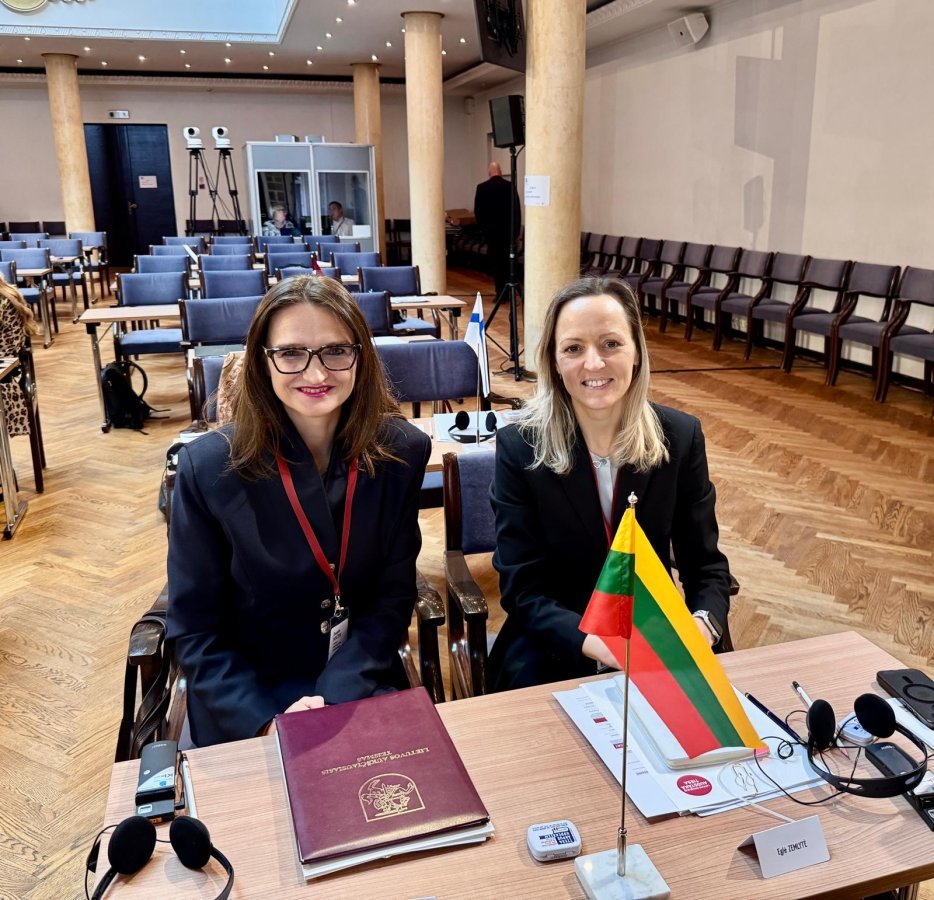
Dr Danguolė Bublienė, President of the Supreme Court of Lithuania, and Dr Eglė Zemlytė, Judge of the Supreme Court of Lithuania, participated in an international conference held in Riga, where judges of supreme courts and scholars specialising in law and other disciplines discussed the impact of judicial decisions on the state, society and the economy.
The President of the Supreme Court of Lithuania delivered a presentation entitled “The Role of the Supreme Court of Lithuania’s Case Law in Shaping the National Economy: Insights from 35 Years of Judicial Practice”. The presentation was part of a discussion session entitled “Court Decisions and the National Economy”, which examined whether judges should take into account the potential economic consequences of their decisions and how the economic rationality of judicial decisions can be reconciled with justice.
Reviewing the most significant case law developed by the Supreme Court of Lithuania over the past 35 years and its contribution to shaping the legal and economic environment, Dr Bublienė discussed criminal and civil cases in which judicial decisions have enhanced legal certainty and predictability and ensured consistency in the Court’s cassation case law.
This case law concerns a wide range of issues, including the restoration of Lithuanian statehood and attacks against the institutions of the restored State, organised crime and political corruption, economic and financial crises, compensation for damage, the balance between creditors’ and debtors’ interests, the reconciliation of business and public interests, environmental protection and consumer rights.
“The case law of the Supreme Court of Lithuania demonstrates that justice is not static. It evolves alongside society and its changing needs, while remaining directed towards a single goal: building a state in which law and the economy work hand in hand,” Dr Bublienė emphasised.
According to the President of the Supreme Court of Lithuania, decisions adopted by the Court in cassation proceedings across different areas of law affect not only the parties to individual cases. They help establish the rules governing the activities of businesses, investors, creditors, consumers and other members of society. They determine whether our market is predictable, transactions are secure and investments are protected. They define the boundaries within which capital operates and provide direction for the development of the entire economic system.
When judicial practice is consistent, clear, predictable and bold, and cases are heard without undue delay while maintaining high standards of quality, the economy can breathe more freely. When judicial practice is contradictory or unstable, risk becomes more expensive and trust gradually erodes. Case law therefore undoubtedly plays an important role in fostering economic stability and confidence in the legal system.
Speaking about economic stability, Dr Bublienė highlighted several important aspects, including the relationship between creditors and debtors. In her view, the legal system must provide for effective protection of creditors’ interests while preserving an honest debtor’s opportunity to overcome temporary financial difficulties.
“An economically stable system is not one in which either the debtor or the creditor always prevails. It is a system in which an honest debtor has the opportunity to overcome temporary difficulties, creditors have effective safeguards, and ordinary business risks and the legitimate interests of third parties are respected,” Dr Bublienė stated.
The international conference in Riga was organised by the Supreme Court of Latvia in cooperation with the University of Latvia. Participants included senators of the Supreme Court of Latvia, judges of the Constitutional Court, heads of other Latvian courts, members of the academic community and representatives of supreme courts from other countries.
When quoting or otherwise disseminating this information, please indicate the source.
Media contacts:
Tautvilė Merkevičiūtė
Supreme Court of Lithuania
Public Relations Officer of the Office of the President
Mobile: +370 685 84863
Email: t.merkeviciute@lat.lt
www.lat.lt


Contacts
The Supreme Court of Lithuania
Gynėjų 6, 01109 Vilnius
Telephone +370 5 2 616 466
Email [email protected]
Code 188602032
E. pristatymas (Electronic delivery system) details:
name – Lietuvos Aukščiausiasis Teismas
address – 188602032
Budgetary institution
Data is collected and stored in the Register of Legal Entities,
Code 188602032
Working hours
I-IV 8.00 – 17.00
V 8.00 – 15.45
Lunch break
12.00 – 12.45
Documents can also be submitted during the lunch break

Website Compliance Application (in Lithuanian)
Publications

Map of courts

