


News
President of the Supreme Court of Lithuania D. Bublienė Presents Challenges in Protecting Digital Rights at International Conference
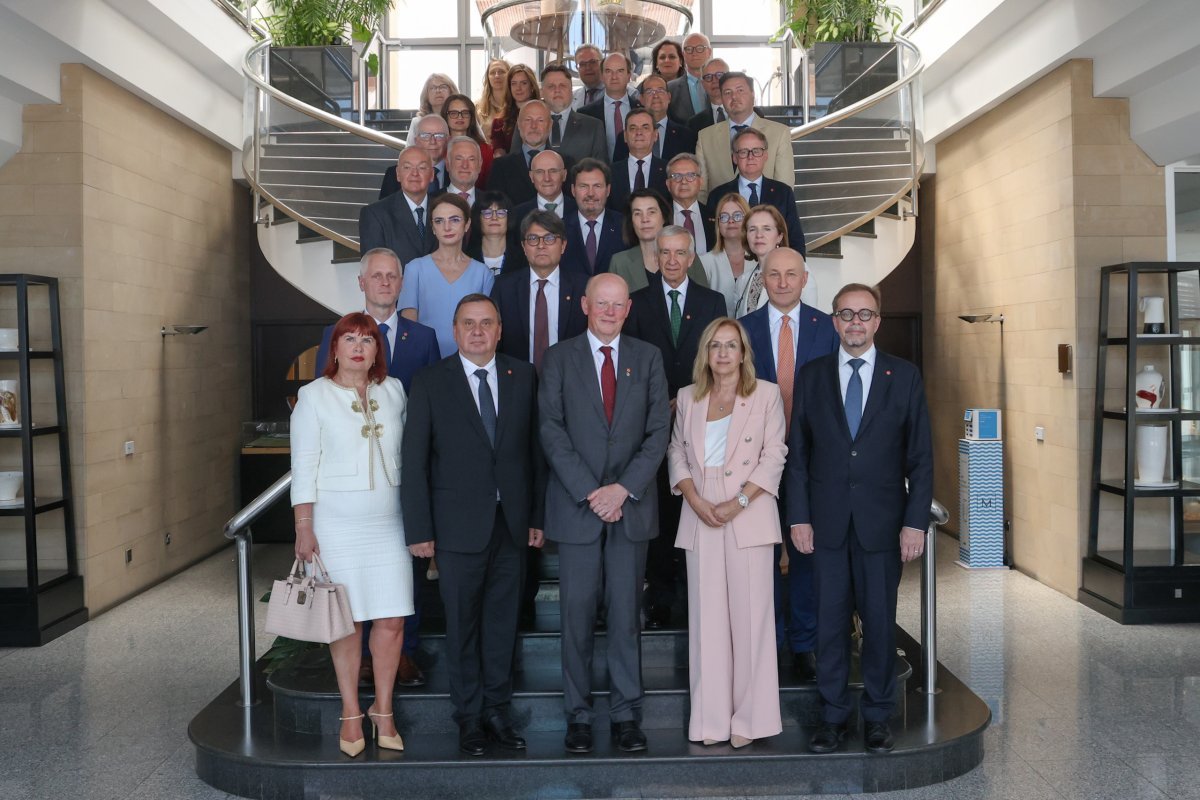
Dr Danguolė Bublienė, President of the Supreme Court of Lithuania, participated in a conference of the Network of the Presidents of the Supreme Judicial Courts of the European Union held in Cyprus. Presidents of supreme courts, representatives of European Union institutions and legal experts discussed the most pressing issues related to the rule of law, judicial independence, the protection of human rights and developments in the digital sphere.
The first part of the conference focused on contemporary challenges to the rule of law. Speakers emphasised that the rapidly changing geopolitical, technological and social environment places new demands on judicial systems and the application of law, including in the areas of communication and public legal education. There is no doubt that the rule of law is essential for democracies; however, lawyers and judges often face difficulties in explaining this concept to the general public in an accessible manner. There is still a lack of clear understanding of various issues, such as what the Court of Justice of the European Union and the European Court of Human Rights have achieved and why both institutions are needed in Europe, why democracy is not limited to elections, what courts can and cannot do, and why judges must be genuinely independent. A significant part of the responsibility for providing legal education to the public rests with the courts through their decisions. However, this is not solely their responsibility. All legal professionals must make efforts to explain the principle of the rule of law to society. It is a shared responsibility.
Particular attention at the conference was devoted to the digital environment and the protection of individuals’ rights within it. The topic was presented and the discussion moderated by Dr D. Bublienė, President of the Supreme Court of Lithuania. The discussion addressed key issues identified by the courts concerning the protection of individuals’ rights in the digital environment, the liability of online platforms, ensuring effective remedies, and the role of national courts in resolving disputes relating to digital services. Participants also considered ways of reconciling technological development with the protection of fundamental rights and ensuring the uniform application of European Union law in the digital sphere.
The presentation emphasised that current challenges, including disinformation, the influence of algorithms on public discourse, content generated by artificial intelligence, manipulative practices employed by online platforms and the dissemination of illegal content, were not foreseen when earlier regulations governing the digital environment were developed. For this reason, the European Union adopted the Digital Services Act (DSA), which aims to ensure a safer and more transparent digital environment.
“Regulation of the online environment cannot be based solely on prohibitions. The European Union seeks to strike a balance between freedom of expression and the creation of a safe digital environment. Therefore, the greatest challenge today is to protect users from harmful and illegal content while at the same time safeguarding freedom of expression,” said Dr D. Bublienė.
The presentation also addressed the initial results of the application of the Digital Services Act. Although there is not yet extensive case-law, certain issues have already emerged concerning the definition of illegal content, including differing interpretations of legal provisions. It was emphasised that content considered illegal in one country may not necessarily be regarded as such in another, and national courts will therefore have an important role to play in developing a uniform interpretation of the law in the future.
Discussing the distinction between illegal and harmful content, Dr D. Bublienė pointed out that these concepts are not identical, although in practice the boundaries between them may become increasingly blurred. The question of whether courts have sufficiently effective means to respond to illegal content directed against the judicial system and judges was also addressed. Protecting judicial independence in the digital environment is becoming an increasingly pressing challenge.
To guide the discussion, she proposed three key questions: whether the Digital Services Act will be applied uniformly across all European Union Member States; whether the convergence of the concepts of harmful and illegal content could lead to excessive restrictions; and whether courts have sufficiently effective means to respond when illegal content is directed against the judicial system and judges themselves. These questions were presented as some of the key issues for future discussion in the field of digital rights protection.
The full presentation delivered by Dr D. Bublienė, President of the Supreme Court of Lithuania, at the conference is available here.
Information on the Board meeting of the Network of the Presidents of the Supreme Judicial Courts of the European Union held on 11 June and the issues discussed during the meeting is available here.
Further information is also available on the following page.
When quoting or otherwise disseminating this information, please indicate the source.
Media contacts:
Tautvilė Merkevičiūtė
Supreme Court of Lithuania
Public Relations Officer of the Office of the President
Mobile: +370 685 84863
Email: t.merkeviciute@lat.lt
www.lat.lt


Contacts
The Supreme Court of Lithuania
Gynėjų 6, 01109 Vilnius
Telephone +370 5 2 616 466
Email [email protected]
Code 188602032
E. pristatymas (Electronic delivery system) details:
name – Lietuvos Aukščiausiasis Teismas
address – 188602032
Budgetary institution
Data is collected and stored in the Register of Legal Entities,
Code 188602032
Working hours
I-IV 8.00 – 17.00
V 8.00 – 15.45
Lunch break
12.00 – 12.45
Documents can also be submitted during the lunch break

Website Compliance Application (in Lithuanian)
Publications

Map of courts

